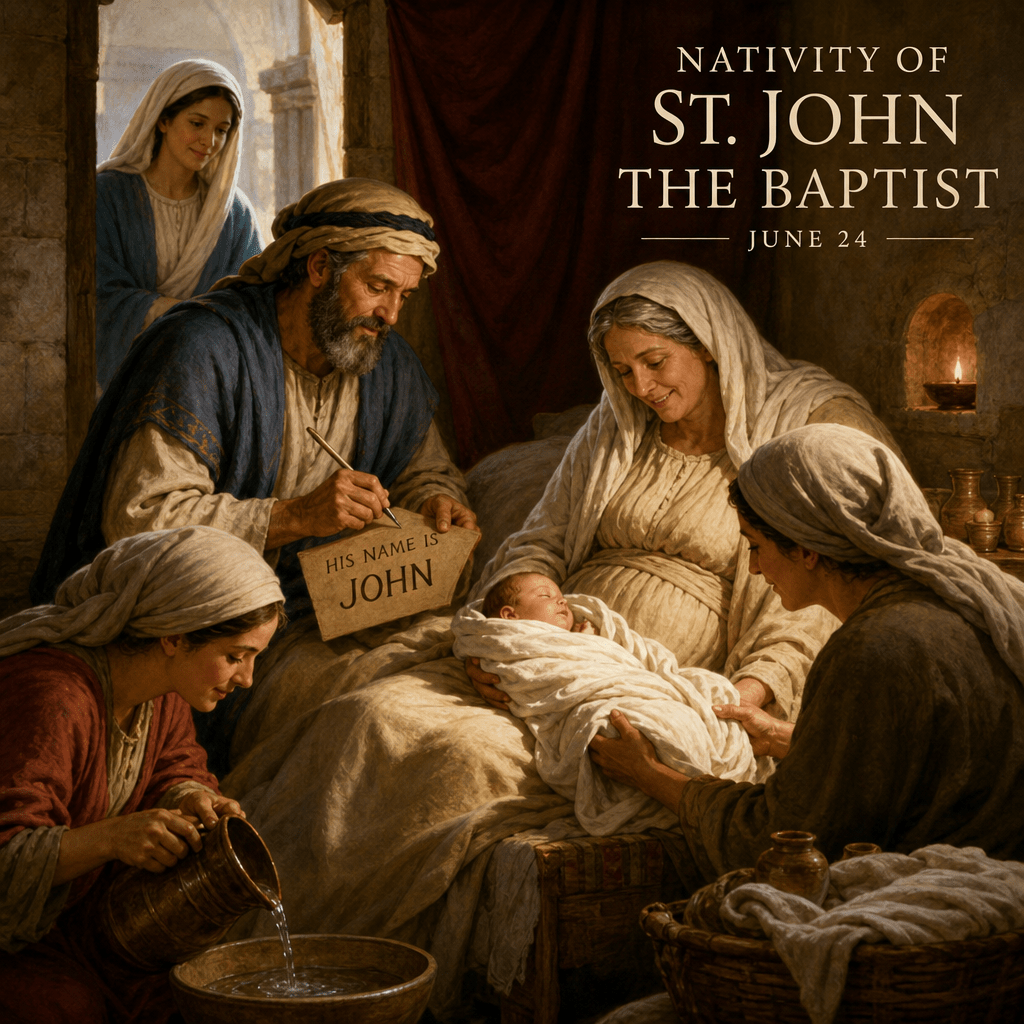
he Nativity of Saint John the Baptist is a Christian feast day celebrated annually on June 24 in the Catholic Church, Eastern Orthodox Church, Anglican Church, and Lutheran Church Wikipedia. It honors the birth of John the Baptist, the cousin of Jesus, who prepared the way for the Messiah and baptized Him ewtnmission.com.
Biblical Account
The only Gospel account comes from Luke 1:5–66. John’s parents, Zechariah (a Jewish priest) and Elizabeth, were childless and advanced in age. During Zechariah’s Temple service, the Archangel Gabriel announced that they would have a son named John, a name unfamiliar in their family. Zechariah doubted, was struck mute, and later, at the child’s birth, wrote “His name is John” on a tablet, restoring his speech Wikipedia+1.
Significance
John’s birth is seen as a miraculous event and a pivotal moment in salvation history. His life and ministry are parallel to Jesus’ in the Gospel of Luke, emphasizing his role as the forerunner of Christ Wikipedia+1. Jesus himself called him “the greatest of those born of women” (Matthew 11:11) Vatican News.
Liturgical Observance
- Date: June 24 (vigil on June 23) Vatican News
- Readings: Often include Jeremiah 1:4–10, Psalm 71, and 1 Peter 1:8–12 The Liturgy Archive.
- Collect: Prayers for families to follow John’s example of preparing the way for Christ The Liturgy Archive.
- Vigil Mass: Held before or after First Vespers on June 23 The Liturgy Archive.
Cultural and Seasonal Context
In many European countries, June 24 is also Midsummer (St. John’s Day), blending pagan and Christian traditions ewtnmission.com. In the U.S., there is no widespread public custom, but attending Mass is considered meritorious ewtnmission.com.
Key Themes
- Preparation for Christ: John’s mission was to call people to repentance and readiness for the Kingdom of God Franciscan Media.
- Miracle of the Birth: Celebrated for the fulfillment of God’s promise to an old couple Vatican News.
- Humility and Obedience: Zechariah’s obedience and John’s humility in serving Christ Franciscan Media.
In summary, the Nativity of John the Baptist is both a liturgical feast and a spiritual reminder of God’s mercy, the call to repentance, and the role of the forerunner in the Gospel story.